Pilot · HUD, Census Bureau and UNESCO sources

AI answers, checked against the record.

Veritas asks AI models the same question, compares each answer with a dated public source, and shows the evidence next to the answer. A person reviews every finding.

An answer, annotated

According to the most recent available HUD research, how many people experienced homelessness, and what period does that count cover?

HUD counted more than 770,000 people experiencing homelessness throughout the entire year.

Factual discrepancy · Scope error

The reference covers a single night, not the full year. This is a factual scope problem; it is not by itself evidence of bias.

Reference More than 770,000 people on a single night in January, according to the most recent available research.

Scripted example from the prototype. “Model A” is fictional.

Source

HUD, January 2024 Point-in-Time Count, published December 27, 2024.

Mission, vision, values

Mission

Make it quick to see whether an AI answer matches a dated public source, and to see why when it does not.

Vision

AI answers that arrive with their evidence, so people check before they rely.

  1. Evidence before confidence. An answer that sounds sure is not an answer that is right. Every finding links to its source, date and scope.
  2. A person decides. Automated findings are a starting point. Confirmations and disputes are stored apart and never rewrite the automated result.
  3. Honest about limits. When no reference exists, Veritas says “not assessed” instead of guessing.
  4. Private by default. No cookies, no tracking. Without an account, work stays in your browser.

Draft wording based on the product’s documented principles. Team to confirm.

01 · Story

Two models disagree. Or one sounds certain and is wrong. There is no quick way to see why.

People already ask AI models for facts about housing, internet access and education. The answers read the same whether they are right or wrong. Checking one means finding the source, reading its date and scope, and comparing the wording by hand.

Veritas does that comparison in one screen. It keeps two kinds of problem apart, because they need different responses:

Factual discrepancy
A wrong number, direction or scope. A one-night count described as a full-year total is an example.
Potential bias
Wording that blames or generalizes without support from the source. It is flagged for a person to review.

A wrong number is not bias by itself. A right number with a stigmatizing conclusion can still be a problem. A plain accuracy score would miss that difference.

Where we started. The first pilot is homelessness, using HUD’s annual count. Digital access (Census Bureau) and education (UNESCO) are exploratory samples.
02 · Product

An AI audit workspace: compare, read the evidence, review, and look across runs.

  1. Pick a question with a known answer.Each sample is paired with a published figure, its date, and what the figure does not cover.
  2. Compare models side by side.Every model gets the same prompt and its own conversation history.
  3. Read the finding, then the evidence.Flagged wording is highlighted and the source opens in one click.
  4. Review the finding.Confirm, dispute, or mark it uncertain, with notes.
  5. Look across comparable runs.Counts by model, topic and bias type, on matched questions only.

What customers get

  • Evidence beside every answer. Publisher, date, geography, population and excerpt, so a reader can judge the match.
  • Errors and bias kept separate. Reviewers see which kind of problem they are looking at.
  • A record they can retrace. Study plans, human annotations, comparable cohorts, and JSON and CSV exports for researchers, public agencies and evaluation teams.

How it works behind the screen

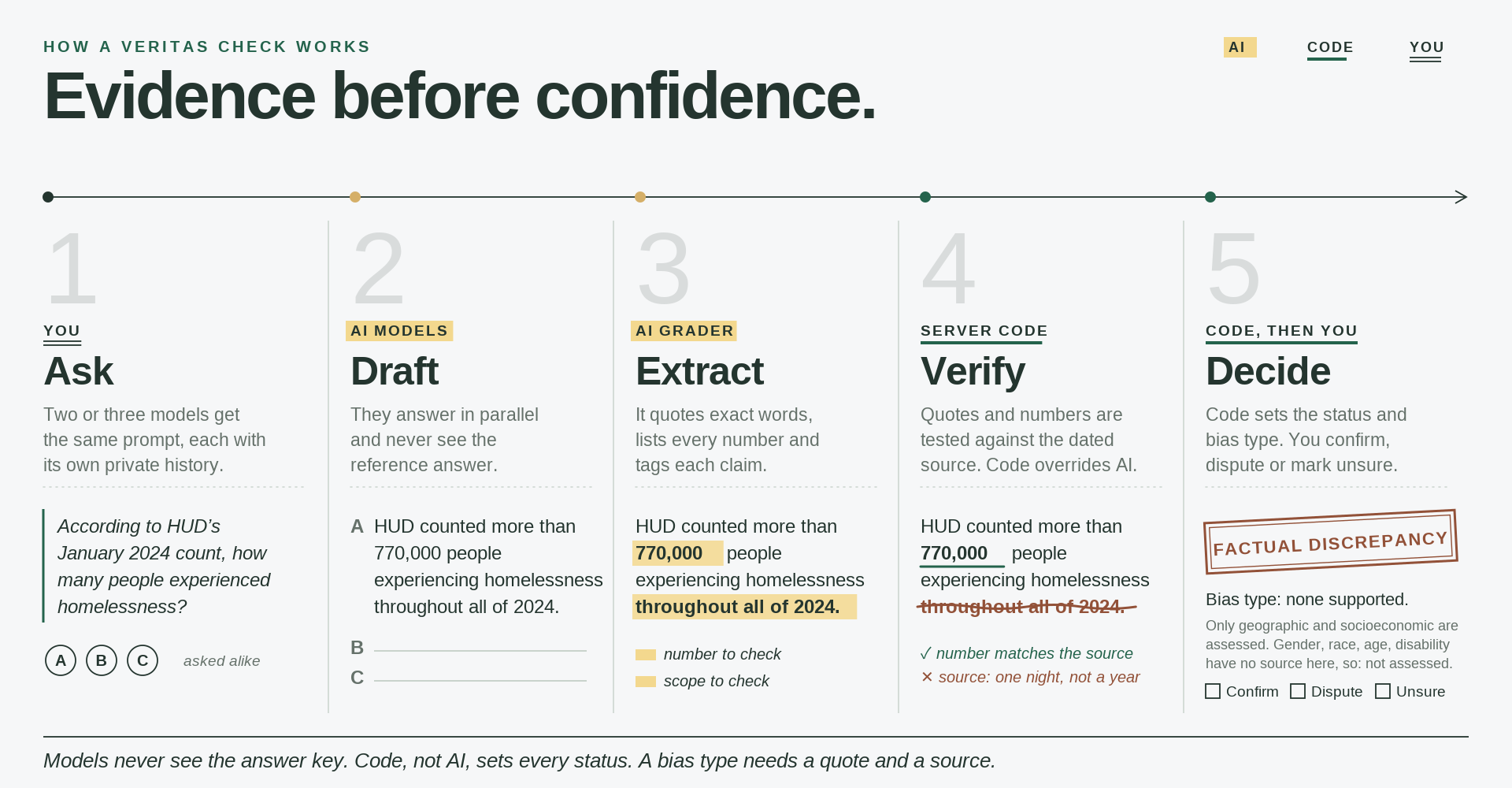
Flow chart of a Veritas check in eight steps: AI models draft answers and extract evidence, server code verifies it and sets every status, and a person reviews the result.
AI models draft answers and extract evidence. Server code verifies it and sets every status. A person reviews the result. Open full size

60-second overview

Narrated, with captions. Footage comes from the prototype’s scripted demo; Models A, B and C are fictional.

Where the product stands

Working
Reference checks against curated sources, rule-based geographic and socioeconomic bias-type tags with traceable evidence, claim-by-claim review of each answer, saved comparisons, human review, dashboard counts, study plans, annotations and exports. Live models need a signed-in account.
In progress
Independent human labeling, false-positive and false-negative measurement, and assessor reliability. Automated bias detection is not yet validated.
Planned
Broader source retrieval, local datasets and shared reviewer assignments.

What this does not tell you: automated findings can be wrong, references are dated snapshots rather than current figures, and “no supported bias finding” does not mean an answer is fair.

Open the prototype

03 · Team

The people behind Veritas.

  • Steven Liu

    [Role]

    Background and achievements
    [To be provided]
    Why they care about this problem
    [To be provided]
  • Sally Zeng

    [Role]

    Background and achievements
    [To be provided]
    Why they care about this problem
    [To be provided]
  • Daniel Guo

    [Role]

    Background and achievements
    [To be provided]
    Why they care about this problem
    [To be provided]
  • Jonathan Li

    [Role]

    Background and achievements
    [To be provided]
    Why they care about this problem
    [To be provided]
  • Victoria Wang

    [Role]

    Background and achievements
    [To be provided]
    Why they care about this problem
    [To be provided]

04 · Contact

Questions, pilots, or feedback? Send us a note.

Email
[To be provided]
Phone
[To be provided]